
In it’s original form, Delaware House Bill 272 was broad enough to criminalize pro-life speech meant to persuade women to choose life instead of abortion.
Delaware citizens pushed back, and HB 272 was amended (substituted) to include more specific 1st Amendment protections.
The fight is not over. HB 272 is still an unnecessary bill that will create a chilling effect on free speech.
HB 272 is scheduled to be heard on June 30th, the final day of session, on the Senate floor.
Contact your Senator today and ask them to oppose HB 272.
Talking Points to Send to your Legislator
HB272 creates a chilling effect on free speech.
- The Federal FACE Act already penalizes actual violence against individuals entering an abortion clinic or house of worship. HB 272 focuses more on speech rather than conduct.
- HB 272 criminalizes “persuading” someone entering an abortion clinic. “Persuading” is undefined, and has no clear legal boundary. This can include peacefully communicating alternative resources, expressing moral or ethical disagreement, and even prayer. This vagueness creates a chilling effect on free speech.
Please vote NO on HB 272!
Talking Points to Send to your Legislator ORIGINAL
HB272 criminalizes free speech.
- The Federal FACE Act already penalizes actual violence against individuals entering an abortion clinic or house of worship. HB 272 criminalizes speech, not conduct – a clear 1st Amendment violation.
- HB 272 criminalizes discouraging someone entering an abortion clinic. “Discourage” is undefined, and has no clear legal boundary. This can include peacefully communicating alternative resources, expressing moral or ethical disagreement, and even prayer. HB 272 will result in viewpoint discrimination.
- HB 272 will invite costly and unnecessary litigation. Because HB 272 presents clear 1st Amendment, free speech violations, passing this bill would open Delaware up to yet another taxpayer-funded lawsuit.
Please vote NO on HB 272!
DFPC Team exposes free speech violations in original version of HB 272
House Bill 272 Analysis
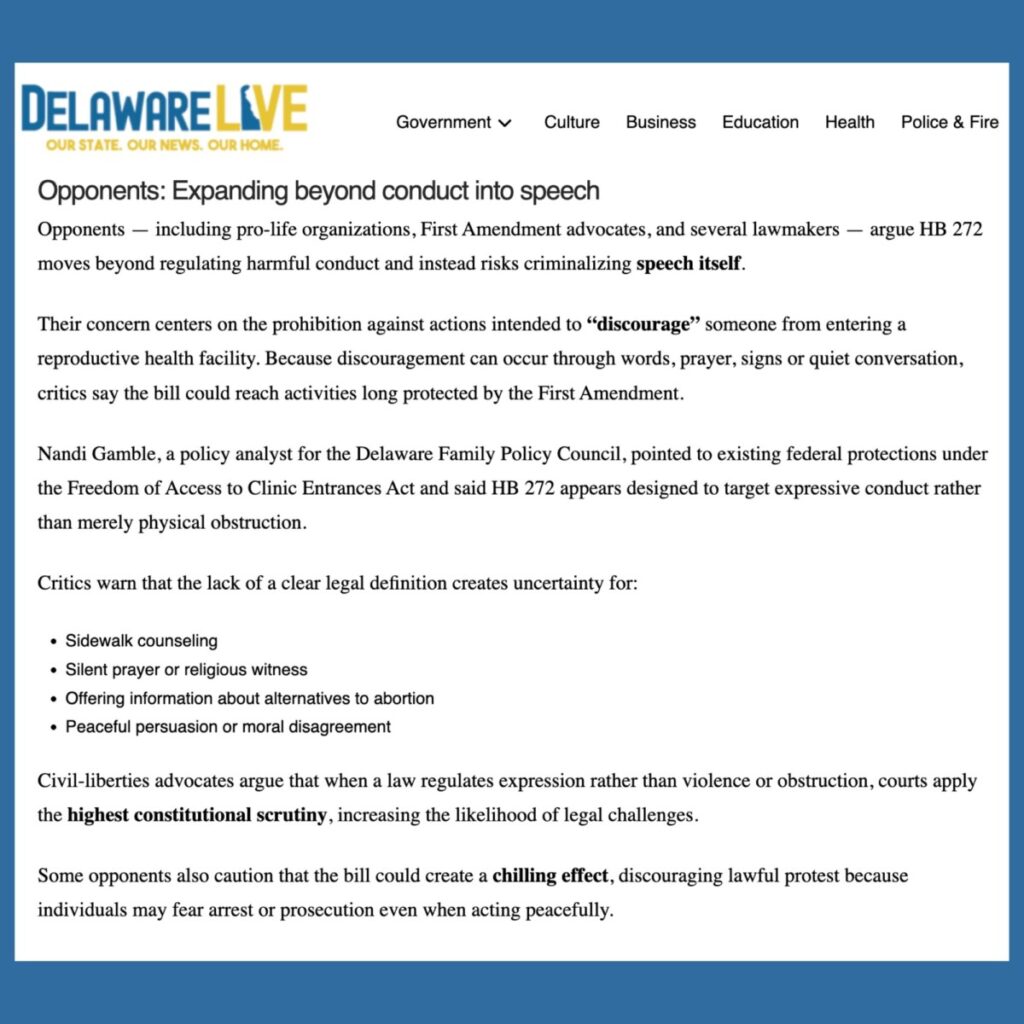
Delaware Live reports on Delaware Family Policy Council’s analysis of HB 272, bringing awareness to its free speech issues.
House Bill 272 is presented as a mirror of the federal FACE Act, which was enacted in 1994 under President Bill Clinton to penalize violence against abortion clinics and houses of worship.
However, the FACE Act enacts civil penalties against conduct, not speech. In its original form, HB 272 would have criminalized any “intent to discourage” individuals entering abortion clinics, which could include actions as simple as prayer or conversation about additional resources.
After HB 272 was released from the House committee, it was substituted to include a specific 1st Amendment acknowledgement, along with other changes, thus mitigating some of the negative impact of the bill.
Read the bill substitute and see the sponsors here.
House Bill 272 was released from committee on January 28th. Listen to the committee hearing with commentary here.
House Bill 272 passed the Senate Judiciary Committee on May 20. Listen to the committee hearing here.
Background: The Federal FACE Act
Enacted: 1994 (signed into law by President Bill Clinton)
Purpose: Address violence, threats, physical obstruction, and property destruction targeting reproductive health facilities and places of worship.
Key Feature: The law regulates conduct, not speech.
Prohibited acts must involve:
Force or threat of force
Physical obstruction
Intentional property damage
Importantly: The FACE Act does not prohibit peaceful protest, counseling, prayer, or verbal persuasion.
This narrow focus has allowed the law to withstand constitutional scrutiny for nearly three decades.
In it’s original form, Delaware’s HB 272 was more extreme than the Federal FACE Act.
1. HB 272 had a vague prohibition against “discouragement.”
In the original verbiage, it was considered unlawful to act “in order to discourage” a person from obtaining or providing reproductive health services.
This language does not appear in the federal FACE Act.
“Discourage” is inherently subjective and lacks a clear legal definition.
It potentially encompasses:
Peaceful conversation
Expressing moral or religious views
Offering alternatives or resources
Prayer or counseling
This represents a shift from regulating actions to penalizing based on intentions and viewpoint.
The bill substitute replaces the word “discourage” with “persuade.” While this is not, in actuality, a substantive difference, the fact that it was changed reflects the weight of the concern placed on the original phrasing.
2. HB 272 criminalized intent rather than harm.
The Delaware bill risks criminal liability based on why someone acted, not what they did.
Two identical actions could be treated differently based solely on perceived motive.
This creates unpredictability in how the law could be enforced and increases the risk of selective or viewpoint-based prosecution.
2. HB 272 has a chilling effect on lawful speech.
Vague standards discourage lawful civic engagement.
When standards are vague, individuals and faith-based groups may self-censor to avoid legal risk.
Laws affecting expressive activity should be clear, narrow, and predictable—this bill was not. The bill substitute reduced some of the vagueness, but still contains undefined verbiage.
Bottom Line
Violence, threats, and physical obstruction are already illegal—and should remain so. The federal FACE Act addresses those harms directly.
Delaware’s HB 272 in its original form went further by criminalizing discouragement, a subjective standard that risks suppressing protected speech, religious expression, and peaceful advocacy. In doing so, it crossed a line the federal law carefully avoids.
Public safety can be protected without criminalizing intent or viewpoints.
After many pointed out the 1st Amendment free speech concerns, Delaware Representatives substituted the bill; the substitute version removes the word “discourage” and includes more specific 1st Amendment protections.
The bill is still not perfect – even the federal FACE Act has still been weaponized to target pro-life advocates. HB 272 is no longer as egregious of a free speech violation; still, the current version creates a chilling effect on free speech.
4. HB 272 increased litigation risk for Delaware.
The FACE Act survived scrutiny because of its narrow scope – it addresses specific actions.
In contrast, HB 272 expands liability to “discouragement,” which increases exposure to:
First Amendment challenges
challenges based on its vagueness as to what constitutes a true violation
Costly taxpayer-funded litigation
5. HB 272’s lack of location limits poses a speech regulation problem.
Unlike the federal FACE Act—which is expressly limited to facilities and places of worship—the proposed Delaware statute does not clearly limit where the prohibited conduct occurs.
The bill does not state that the conduct must occur:
at or near a clinic,
at a medical facility, or
within a defined buffer or access zone.
Instead, it broadly criminalizes conduct done “in order to discourage” someone from obtaining or providing abortions—without any sort of geographic limitation. This is a serious problem because the language potentially applies anywhere, including:
private homes
churches
counseling offices
Public sidewalks
In effect, the bill functions less like a clinic-access law and more like a conversion-style speech ban—penalizing efforts to persuade someone to change their mind about abortion.
This bill attempts to control what people are allowed to say or encourage, rather than stopping force or obstruction. The result is not protection of access—but government control over persuasion itself.

PAID FOR BY DELAWARE FAMILY POLICY COUNCIL
This site is not a part of the META (formerly Facebook) website or META Inc. Additionally, this website is not endorsed by META in any way. META is a trademark of META, Inc.
This page, its content, and any advertisements, messages, or notifications pointing to this page are Paid for by Delaware Family Policy Council Inc., a 501(C)(4) organization. This page was created by Delaware Family Policy Council, and is used for the purpose of communicating our views on issues that impact families.
© 2023 Delaware Family Policy Council.
All rights reserved.
info@delawarefamilies.org | 302-296-8698 | POB 925 Seaford, DE 19973 | facebook.com/DelawareFamilies
Statement of Non-Violence
Privacy Policy